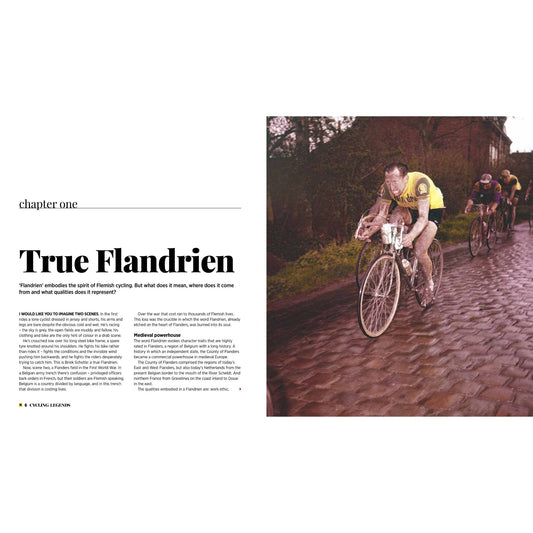

This is Paris-Roubaix in 1994. All the favourites are together with Johan Museeuw leading and eventual winner Andre Tchmil on the far left but look at the bikes. Many of them aren’t those teams rode the rest of the year.
Shortly after suspension systems were developed for the mountain bike market, Paris-Roubaix riders started using front suspension systems. Gilbert Duclos-Lassalle (following Museeuw in the photo) won Paris-Roubaix in 1992 and 1993 using Rock Shox Paris-Roubaix SL suspension forks. Both he and Tchmil are using them in this shot.
The forks were road adapted versions of Rock Shox Mag 21 XC mountain bike forks. They had modified internal air springs and damping, and a raised fork bridge so a calliper front brake could be attached to it. Rock Shox later developed a road specific Ruby fork, but it didn’t catch on for general road use, although the idea of suspension stayed in Paris Roubaix for a while.
Front suspension became ‘de rigeur’. Then Duclos-Lassalle and Greg LeMond used custom-built titanium frames with soft-tail rear suspension. And here in 1994, Johan Museeuw rides a Bianchi full suspension road bike featuring a single-pivot swingarm, and a short aluminium seat tube-mounted rocker link, driving a small coil shock.
Unfortunately, the bike broke near the end when Museeuw was in 2nd place and chasing Tchmil. A slow change and the extra effort after it contributed to Museeuw dropping back.
But by far the most ‘out there’ bike used in Paris-Roubaix was the ‘Stealth’ ridden in 1993 by Canadian 1990 Roubaix runner-up, Steve Bauer. It was made in the Eddy Merckx bike factory and was the brainchild of Richard Dejonkheere, who is the elder brother of ex-pro racer Noel, who worked for Bauer’s Motorola team.
Dejonkheere thought positioning the saddle well over the rear wheel would provide more traction on rough surfaces, so it had 60-degree seat angle. That gave the bike a longer wheelbase, and with its suspension forks it looked like a chopper bike. Bauer finished 21st and the bike wasn’t used again.
Read more about Paris Roubaix and Belgian cycling in Cycling Legends 04: Flandriens - cult heroes of the cobbles. Find out more here.