


Today is July 13th, and it’s 59 years since the death of Tom Simpson on Mont Ventoux, during the 13th stage of the 1967 Tour de France. For once, though, let’s not stop on that ferocious mountain in Provence. Let’s climb on…
We’re not going to freeze Tom Simpson in eternity on that back road in a white moonscape. Let’s give him something history can’t; a tomorrow, and the days after, and 1968 and on and on.
What would Tom have achieved? Because 1967 was not meant to be an ending, it was meant to be a year of change and a new, even better future.
Tom was 29 years old. Not young in the soft sense, because he had been a professional since August 1959. Had raced in the hardest years, on the hardest roads, against the hardest men. But 29 is not the end of a great rider.
As no less than Sean Kelly pointed out when Chris Sidwells interviewed him for a GCN documentary about Tom; “I was 27 when I won my first monument, Tom was 23; that’s a very big difference.”

On the attack in Milan-San Remo in 1964
And look how well Kelly did, he won 9 monuments in his career. For a rider of Tom’s intelligence, range and ambition, 29 could have been the beginning of the most complete phase of his racing life, and change was already waiting for him.
Since early 1965, the two great Italian teams, Molteni and Salvarani, had wanted Simpson. They knew what Italy knew about him. He’d won Milan-San Remo in 1964, then Il Lombardia in 1965. He was not some foreign curiosity, he was a British rider who understood Italian races, and perhaps more importantly, the Italians understood him. He had style, cunning, hardness and class. He had friends too, not least Felice Gimondi, Salvarani’s leader and one of the finest riders of the age.
But Tom couldn’t join any other team in 1965, he was tied to Peugeot-BP. He couldn’t walk away, Peugeot made it clear that if he tried, they would not select him for the Tour de France. In the 1960s that was no small threat. The Tour was not only the Tour, it was the gateway to post-Tour criteriums and track contracts that made a rider’s season really pay. So, Tom stayed.

Mobbed by crowds after winning the Worlds in 1965
Then came 1967, and the Tour returned to national teams. For once, Peugeot had no hold over him for the Tour. Tom was free to plan the next part of his life. He signed for Salvarani for 1968, at a great deal more than his Peugeot salary. Salvarani even threw in a fitted kitchen for the lovely new house he was having built in Mariakerke, outside Ghent.
That detail matters; a kitchen, a home; a future.
So, what might have happened?
Start with the monuments. As things stand, Simpson won three; Milan-San Remo, the Tour of Flanders and Il Lombardia. No other British male rider has come close to that number or breadth. Mark Cavendish, the only other British man to win a monument, won one, Milan-San Remo. Cavendish is also the only other British male rider to win the elite road race world title. Simpson did both in an era when British riders were supposed to be grateful just to survive on the Continent.
Rik Van Looy, the Emperor of Herentals, once told Chris Sidwells he thought Tom could win any of the five monuments. Paris-Roubaix, he admitted, might have been a stretch. But even there, Tom was not an outsider. He finished sixth behind Van Looy in 1965, and was three times in the first ten in only 5 participations… That’s not romance, that’s evidence.

Tom with wife Helen and daughters Jane (left) and Joanne
Could he have won Roubaix? Perhaps not. The race belongs most naturally to heavier men, to bulldozers with judgment. Tom was hard enough, certainly, but his greatest gift was not brute force. It was elasticity. He could climb, sprint from a group, time-trial, read a race, survive weather, and turn opportunism into strategy.
Roubaix would always have been the least likely, but least likely is not impossible.
Liège-Bastogne-Liège feels different. That was surely within Tom’s reach. So was another Lombardia and another San Remo, especially with an Italian team around him and Gimondi beside him rather than opposite. Salvarani might have given Simpson something Peugeot never quite did; a structure that believed in him not as an awkward foreign asset, but as a star worth building around.
And then there’s the world title.
Tom won in San Sebastián in 1965, not by accident or by ambush but by being the strongest and smartest at the end of a savage race. Could he have won another? Yes; not easily, because no world title is easy, and the late 1960s were filling with giants. Eddy Merckx was coming, Gimondi was already there, as were Jan Janssen, Rudi Altig, Van Looy, Michele Dancelli, Walter Godefroot, none of them were handing anything over.
But Simpson had already beaten men of that quality. He was not intimidated by reputations, he collected them like scalps.
The fascinating thought is not that Tom would have dominated. He would not. Merckx would soon change the scale of cycling, but Simpson might have been of the men who made Merckx work for it, especially if he combined well with Gimondi.

What would the future have held...
Perhaps he wins Liège. Perhaps he wins a second Lombardia. Perhaps he never wins another monument but collects podiums and near-misses that deepen, rather than diminish, his reputation.
Perhaps he rides the Tour differently once he is free of Peugeot, hunting stages, wearing national colours with less pressure, then returning to the professional calendar with Salvarani money, Italian affection and Belgian permanence.
And perhaps, after racing, he becomes what he was already becoming; a bridge. Britain’s first true European professional champion, not as a museum exhibit, but as a living adviser, manager, mentor, commentator, talent spotter, patron saint with mud on his shoes.
Imagine what a living Tom Simpson might have meant to British and English-speaking riders in the 1970s and 1980s. Imagine him advising Barry Hoban, talking to Phil Anderson, recognising Robert Millar’s ferocity, understanding Sean Kelly’s silence, seeing in Cavendish not just a sprinter but a killer of moments. And in Bradley Wiggins maybe even seeing himself.
That’s the ache of it. Not only the races unwon, but the knowledge ungiven. And of course, let us not forget the life unlived….
Tom Simpson’s career, as it stands, is already monumental. Three monuments, a world title, yellow in the Tour, Paris-Nice, Bordeaux-Paris, Il Lombardia in the rainbow jersey. He was a British rider decades ahead of his country’s imagination. But if he had ridden on, we might not remember him mainly through loss.
We might remember him through continuation; the Italian years, the Mariakerke house, the fitted kitchen, the late victories, the near things, the wisdom, the warnings, the laughter, the stories.
The road on Mont Ventoux took that away. So, for a moment, on this anniversary of his death, it is worth looking beyond the mountain and seeing not how the Tom Simpson story ended, but how much of that story there was still to come.
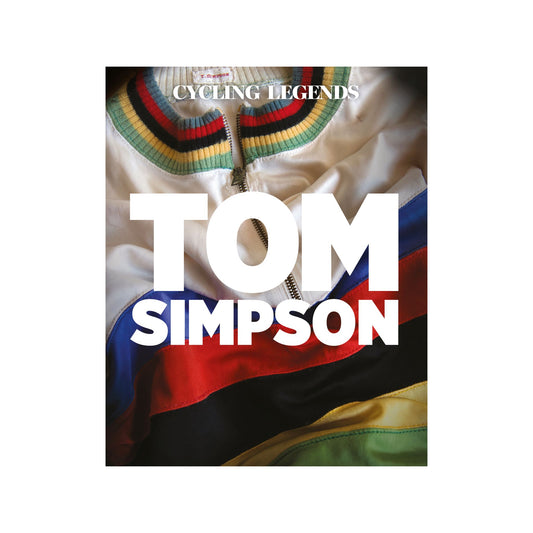
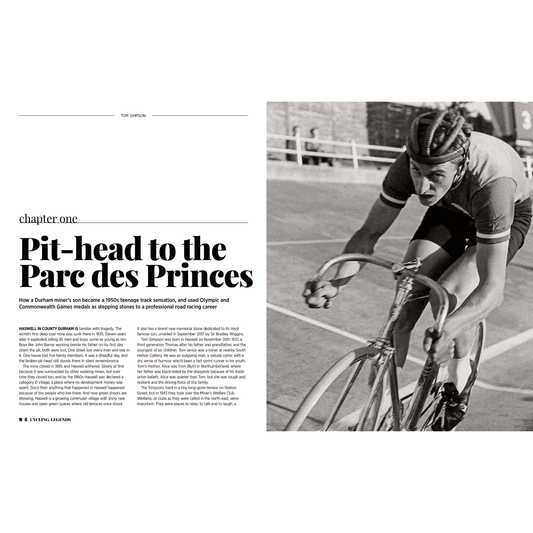
Read more about Tom Simpson in Cycling Legends 01: Tom Simpson by Chris Sidwells - https://cyclinglegends.co.uk/products/cycling-legends-01-tom-simpson

Felice Gimondi (centre) the day after Tom's death in 1967
Photos: Cycling Legends Collection.
1 comment
A very fine tribute