

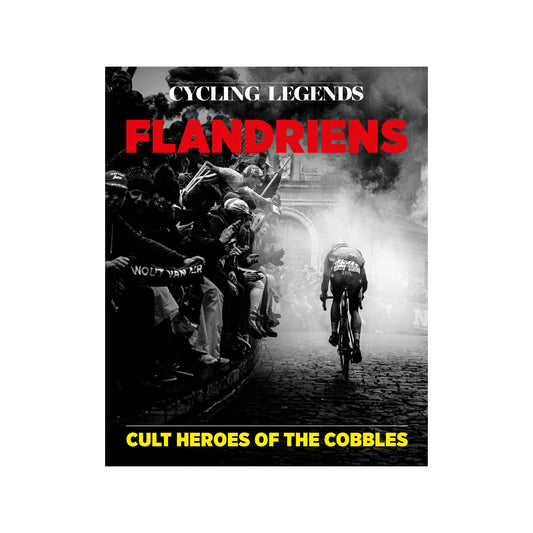
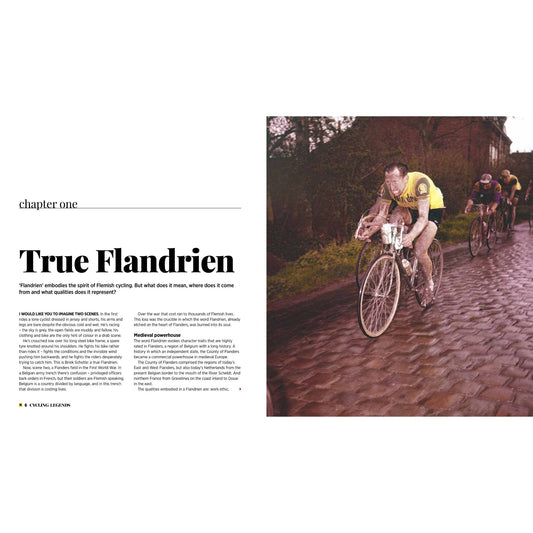

He did not just win bicycle races; he arrived in them, there’s a difference. Jacques Anquetil, the man and the image.
Many champions dominate by force, by warmth, by aggression or by making fans feel their effort. Jacques Anquetil seemed to glide into the centre of things already complete; pale-eyed, immaculate, unreadable and beautifully arranged. On the bike he was a metronome. Off it he often looked less like a sportsman and more like a figure of the new France, the France of cinema, travel, motor cars, Riviera light and sharp modern clothes.
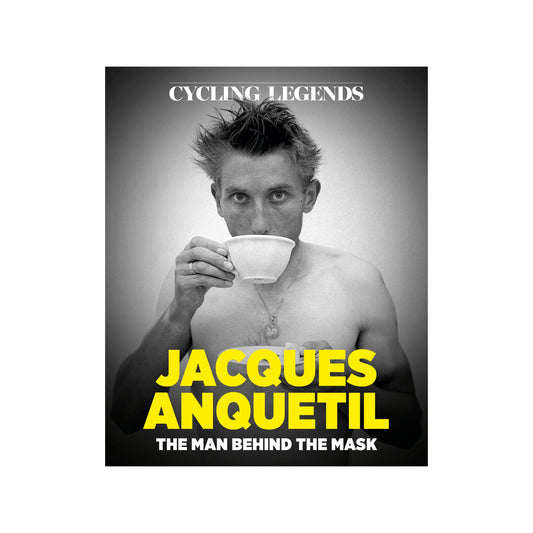
The fashion designer Sir Paul Smith, who wrote the foreword to our book Cycling Legends 03 Jacques Anquetil, the man behind the mask, saw it. As a young cyclist he looked at Anquetil and saw not just a champion, but a style.
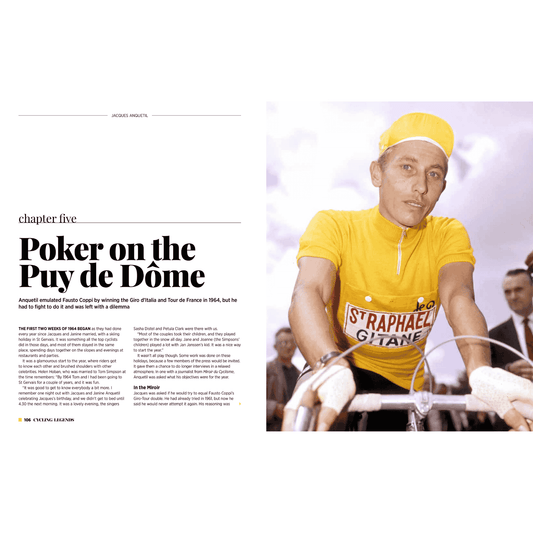
“I’ve always thought cycling was a cool sport. When I was a young cyclist, just 14 years old, I looked at Jacques Anquetil and decided there was a man who defined cycling cool for me, thanks to his good looks and that red and white St Raphaël jersey. I haven’t changed my mind.”
That’s a revealing phrase: “cycling cool.” Not cycling heroism, cycling toughness, cycling glory, but cycling cool. Anquetil’s great racing years, from 1957 to 1965, coincided with a time when France was presenting a new image to the world.
Modernity
Postwar austerity was giving way to modernity. France of the 1960s was France of the autoroute, the airport, the hotel lobby, the terrace, the magazine photograph; the film close-up. It was the world of the French New Wave, of Alain Delon and Jean-Paul Belmondo; slim suits, narrow ties, sculpted hair and cigarettes held like question marks.
Anquetil belonged visually to that world, not slightly crumpled like Belmondo perhaps, but closer to Delon. Controlled, handsome, reserved, a little distant, with an elegance that looked natural because he never seemed to be trying.
Even in racing kit, Anquetil carried himself as though he had been designed. The St Raphaël jersey helped. Its red, white and either grey or pale blue blocks gave him one of the most recognisable graphic identities in cycling. It was clean, bold, commercial and unmistakably modern. On him it became more than a sponsor’s jersey, it became part of Jacques Anquetil in people’s minds. Indeed, the jersey and Anquetil have been represented in art that way.
With his instinct for the visual of cycling, Paul Smith understands that. “I was attracted to it by cycling’s sense of style,” he says. “Things like Fausto Coppi’s sunglasses, Jacques Anquetil’s jerseys and the beautiful graphics on a piece of Campagnolo have provided a regular inspiration in my own work.”

Anquetil (centre) knew the camera was on him
Sporting style
Anquetil has a place in the history of sport, but also in the history of sporting style. Coppi had the sunglasses and the long postwar elegance. Campagnolo, the precision and graphic beauty of Italian engineering. Anquetil had the jersey, the hair, the face, the carriage, the slightly aloof air of a man who knew the camera had found him.
In a suit he is rarely flamboyant, and that’s important. Anquetil’s style is not theatrical, certainly not in the way Mario Cipollini was, it is restrained, sixties European and precise. Jackets are neat, shirts pale and plain, ties narrow, trousers fall cleanly.
Anquetil’s hair is swept back and sculpted in the unmistakable language of the late 1950s and early 1960s. He looks like a man who could walk from a Tour de France stage to a film premiere without needing to change very much. “He looked good off his bike too,” Smith says, “always with a smart suit and a fashionable hairstyle. He stood out.”
Standing out was not accidental, Anquetil understood presentation, so did his wife Janine. She influenced his ‘look’ from the moment their relationship began in 1957. She was slightly older than Jacques, had been married before and she had travelled. She understood fashion and presented herself with thought and care. They went everywhere together; Jacques and Janine were the glamour couple of 1960s cycling.

Jacques and Janine perfectly presented
Composition
Anquetil understood the value of looking composed on and off the bike. He quickly saw that a champion’s image could extend beyond the finish line. His coolness was not just a matter of clothing, but clothing helped articulate it, and he worked on it. A smart suit confirmed what his racing style had already suggested; here was a man in control. His control created a sense of awe, even in his rivals. Under the polished surface and glamour Anquetil was often wracked with self-doubt, but no one outside a tight group knew it.
Control was his public essence. Anquetil’s racing was built on measurement, rhythm and command. He won against the watch with chilling fluency. He made effort look private; he would never show pain for fear it provoked attacks.
He rarely seemed dishevelled in races, even when surrounded by disorder. In an age when many champions were portrayed as labourers of the road when suffering, Anquetil looked the opposite. Yet he could suffer like no other, it was one of his greatest powers.
His most loyal lieutenant and close friend, Jean Stablinski said in our book, “If Anquetil had to hang on to save a big race, even the greatest climbers could not drop him. He would stay with them no matter what they did, until close enough to the finish to limit his losses.”
French style
The French style context matters. The late 1950s and early 1960s saw men’s clothing move away from the heavier, boxier look of the immediate postwar years. The silhouette became cleaner and younger. Parisian designers such as Pierre Cardin helped sharpen the idea of modern menswear; narrower lines, less bulk, more architectural simplicity.
In popular culture, cinema carried that look around the world. The male icon of the period did not need decoration. He needed a good jacket, good hair, a pale shirt, a car, and an expression that gave little away. Anquetil had them all.
There was also something distinctly Riviera, another 60s fashion style, about him; open-topped cars, summer roads, the restaurant terrace, mountains, sunlight, travel. He and Janine appear like characters in a European film still, poised between leisure and performance.
Even the casual clothes have significance. A striped sweater, light trousers, a fine knit, open-neck shirt: these are not revolutionary garments, but on Anquetil they become part of the same visual code. Ease. Affluence. Youth. Distance. Modernity.

Anquetil and St Raphael as art by James Straffon
Different
This is why Anquetil’s look was different from that of many earlier champions. Fausto Coppi had grandeur and melancholy. Louison Bobet had polish, but of a formal and patrician kind. Charly Gaul looked otherworldly, but readily displayed emotion. Anquetil had something sharper and more contemporary. He looked like the man 1960s cycling needed; elegant, technical, fast, emotionally opaque and unmistakably photogenic.
Then there was the contrast between the body and the clothes. Anquetil was an athlete, but not in a muscular heroic style. His physique was lean, efficient, almost spare. His clothes didn’t hang from a V-shaped sporting frame; they followed a slim, controlled line.
In racing kit, the same narrowness made him aerodynamic before aerodynamics became part of cycling’s language. The result was a rare unity between body, bicycle, jersey and public image.
To say Anquetil curated his look may be slightly modern language, but it’s true. Champions have always understood image, even before the machinery of branding became explicit. Anquetil’s image was deliberate but not made of slogans. It was made of repetition; the hair, the pale face, the composed suit, the beautiful car, the almost amused detachment. He looked as if victory had confirmed something he already knew; that he was the best. It commanded respect from fans and rivals alike. It intimidated rivals too; it was designed to.

Jacques, Janine, the car, the Riviera look
Defining cool
That is perhaps what the young Paul Smith recognised. Anquetil not only looked successful, but he also looked cool, and cool is more elusive than success. Success can be measured, cool depends on distance, timing, proportion and the refusal to explain oneself too much. Anquetil possessed all those qualities.
His career belongs to cycling history: five Tours de France, two Giro d’Italia, the Vuelta a España, the hour record, the great time trials, the duels, the controversies, the appetite for life. But his image belongs somewhere wider. It belongs to the story of how cycling, in its most stylish moments, has overlapped with fashion, cinema and design.
The St Raphaël jersey mattered because it was graphic and modern. The suits mattered because they placed him in the world beyond sport. The hairstyle mattered because it connected him to the visual language of his era. The cars, hotels and travel photographs mattered because they made him part of the new mobile Europe. And the face mattered most of all, because Anquetil’s face seemed to say what his racing did; I am here, I am in control, and I am not going to tell you everything.
But that assurance masked what lay beneath. It was what people saw, including his rivals, but very few knew the real Jacques Anquetil. With their help, and the help of many others we reveal that reality in our book; Cycling Legends 03: Jacques Anquetil, the man behind the mask. The fashion worked, but there was far more to this enigmatic man. Sir Paul Smith knows it, which is why he wrote our foreword.
1 comment
Jacques anquetil simply the coolest cyclist of all time a true ledgend and icon a truly great cyclist and sporting querio